Friday, February 15, 2013

How Tommy and Ricky and Lucy Won The War


I'm beginning this post with an unusual offering from YouTube, and I hope you take a moment to view it.

What do you hear in these two songs produced in 1962 in Czechoslovakia? What do you see on screen, especially in the second song?

The 'trombone flash mob' (decades ahead of its time) looks back shamelessly to Tommy Dorsey and the other great big bands of the 1930's and 40's. It's wonderful writing and playing, light-hearted, cleverly filmed. It's American Jazz, created performed some eight times zones away from New Orleans and Chicago.

The second song is based again in American Jazz...our protagonists in the car are a close knock-off off Ricky and Lucy, complete with a clownish side kick to keep things moving. Or, if you will, a Rob and Laura (Dick van Dyke show anyone?) complete with a Morey Amsterdam knock-off!

Now look back at 1962...lessee...Bay of Pigs just past us, the mortar on Berlin Wall still hardening...everybody armed to the teeth...John LeCarre's The Spy That Came In From The Cold fresh on the market,  Dt. Strangelove in the air. And Tommy Dorsey and Ricky and Lucy enthusiastically emulated behind the Iron Curtain. In a way, it's as if the West had already won the contest, but no one sent news back home.

Fast forward to 1987, everybody's on edge again, and...

Billy Joel shows up in Moscow


Notice the shot about 23 seconds in....

It's easy to be simplistic, tempting actually, to advocate some idea of 'Let's all just hold hands and sing and peace will descend upon the planet.', but we all know that life is not like that. If that model worked, we would have arrived at that point in the 19th Century with Beethoven's Ode To Joy.  Game/set/match/I'll buy the first round of beers.

Life is not like that, not remotely. It's messy out there.

However, what composers and performers and teachers of music do really does matter. Music really moves the cultural ground under people's feet, for better or worse. The music industry (aka 'Duh Biz') would have you believe the lie 'We just reflect culture, we don't form it, so you can't criticize anything we produce and sell, don't matter none, just let us get on with making moh' munney-hunney...' 

It matters, a lot. Enough that Islamic fundamentalists attempt to ban music, and fundamentalists and despots of all persuasions attempt to control and expropriate it for their own ends.

So I suggest we remember a few simple facts:

Not everyone can do what we do, even though we don't understand how people can't do what we do.

We create things that burn into the hearts and minds of our audiences, if we're doing our jobs properly. We create lifelong memories, for better or worse. We shape the language of the culture, for better or worse. Think on the moments when you have had to pull the car over to the curb to recover from a song you heard on the radio for the very first time.

That's what we do, if we're doing our jobs.

All this written to give a word of encouragement and hope. If we're doing our jobs, we move the world around us, in ways we often don't understand or even see immediately, and we get to move it in a good direction.

Back to work.


Wednesday, July 25, 2012

Collaborators And Creations: Benjamin Harlan

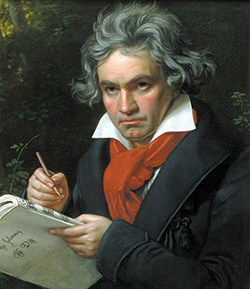
For some, composing music involves sitting alone in a room, sometimes with a piano, tapping into some corner of TheMysticalUniverseOfSound and pouring it onto the page. The idealized images of Beethoven ThinkingDeepThoughts are just that--idealized images.
Ludwig's sketchbooks are revealing,  demonstrating the distance between his initial ideas and finished products. I've done my share of this sort of composing, and it can be grinding work; very satisfying once completed, to be certain, but it is a slog in the middle of the process. It's well, lonely, three minutes into that seven-minute piece. Minute seven may be days away, and there's no way out but forward.

I therefore love to collaborate--with other composers, with conductors, poets, performers, publishers. I prefer to write with a goal in mind, and with people who have clear goals. Sometimes, they give me an idea of what they have in mind; other times, the roles reverse.


One of those long-time collaborations is in the arena of American Protestant church music with
Benjamin Harlan.

If you have sung in a Protestant church choir in the past quarter-century, odds are you have sung his music. His resume includes the dean's chair in the music school of Southwestern Baptist Theological Seminary, head of music ministries for the Louisiana Baptist Convention, and hundreds of works published. He's an inspiring choral conductor, teacher, and one of the jolliest souls one could ever hope to meet.

He definitely has a goal--to restore hymns back to congregations in the pews. The wholesale post-modern experiment that ditched the hymnal in favor of Powerpoint and 'praise music' (whatever that is...) has been a dismal failure. Benjie has labored mightily these past several years to create a body of work that restores sanity, crafting versions of the standard hymnody that encourage the people in the pews to sing again, with the choir and instrumentalists in a supporting role. He writes, he publishes, he travels, he conducts, he teaches. He releases a new collection of hymns every year.  If you wish to purchase a copy for your church, he'll make it available. More than anything, though, he wants to talk with you, not just sell you something. Email him here to begin the conversation.

His goal is one I share, thus the years of work together. Along the way, we together created a library of orchestrations to enhance a selection of the arrangements.  I hear reports from all corners that these collaborations work well, and it brings joy to the heart. 

If you're interested in knowing more, email Benjie at the link above, or leave word below. I don't just want to sell you stuff either--the publishers have made an art of that, and look where it got us. I want to talk to you as well, as I know that the conductor, the musicians and the congregation are all part of the collaboration that makes these pieces succeed so well.


Thursday, July 19, 2012

Sibelius Software, The Musician's Friend--About To Be Ridden Off Into The Sunset

These are tough times for those in the highly specialized business of music composing/editing/engraving software. Both major platforms, Finale and Sibelius, are housed in troubled firms.

Avid, the firm that brings us Pro Tools, bought Sibelius a few years back. It was going to be wonderful--the integration of Pro Tools with the slickest music notation program in history.

(I wondered how this could happen, because I have yet to work a recording session when Pro Tools didn't crash at the most crucial moment. When budgeting, I build in time and money for the Pro Tools crash. It's gonna happen, as surely as the sun rises in the morning.)


It didn't quite work out. The development team in the UK has been put out onto the street, while Avid assures everyone of their commitment to the brand. Just how does that happen, when the brain trust who carries the product in their heads has been dispersed? It's sort of like NASA--who disbanded the team that put man on the moon, once they had put man on the moon. All that's left are memories and a few left-over Saturn V boosters on display in Huntsville, Alabama.

Fail!

So, I'm putting my two cents in, for what it's worth. I left this on the Avid site, but doubt it will see the light of day there.

It's a small matter in a big world where people think it's somehow a good thing to blow up school buses full of children, as happened yesterday in Bulgaria. But for those of us who are left to respond to that sort of madness by composing music, it matters that Sibelius not be orphaned and left to die.

Dear Avid: I am a composer/arranger who trained with the pencil and pad, old-school. I still employ it extensively.  However, my good friend Dave McKay, your best friend in Nashville, showed me how Sibelius can allow me to think like an old-school composer and still take advantage of software for editing, storage and transmission. It has been a great tool, and my dear bride now sits at her desk, typesetting and editing her annual choral series--in Sibelius 7.

Have you noticed something in all these comments, if you have bothered to read? Do you realize that you have extended your middle finger to your avidly (pun intended) loyal customers? Do you realize that a lot of them will remember this month when it comes time to make a purchasing decision between your DAW and other pro products and those of your competitors? Do you realize that your growth has come from positive word-of-mouth from your customers? You can spend kajillions on sexy displays at trade shows, but it's the actual users, comparing notes over beers, that make or break you.

Are you really that out of touch? Didn't anyone mention this before that MBA was handed to you?

Now, about outsourcing to Ukraine, or wherever: Have you heard the news that a lot of places in the world don't operate with high ethical standards? When your code is plagiarized twelve-ways-to-Sunday by your 'bargain-rate' programmers, where are you going to go in the former Soviet Union to file that lawsuit, get the prosecutor to go to the judge and have the perpetrators prosecuted? Does anyone ever think this stuff through--the questions about real costs, about the long-term health of a business, about what happens when an entire customer base is alienated?

Anyone?

If costs of operating in London were so high, there are some alternatives, like Scotland, Northern Ireland, Ireland, Wales, the Channel Islands. Your team could probably be persuaded to relocate there, within a day's drive of families and good English schools for the kids.

Does anyone ever think of these things? Anyone? Ever?

Have the lessons of GM, Chrysler, Sears, Merrill-Lynch, hundreds of local banks, Rover, SAAB, and other spectacular members of the Failure Hall of Fame ever sunk in? Do you think you are immune, because you are, well, you? Those guys all thought the same thing, as they drove their firms over the cliff into the sea.

You have the inalienable right to go broke--that's what the free marketplace is about. What your customers are telling you is that they do not share your desire for sea-water in their lungs.

Good luck. Think this through, while you can. You only have a few days left in all of human history to make the right decision.

Saturday, May 19, 2012

The Passing of Dietrich Fischer-Dieskau

The news of Dietrich Fischer-Dieskau's passing arrived this weekend. Memories flooded back, principally of hours spent in the Peabody College music library listening to those well-loved Deutsche Grammophon discs, thumbing through the dog-eared Schubert and Schumann editions; listening to that voice! It was a classical performer's voice that was as fresh and recognizable as any comparable pop artist.

Everyone can identify Sir Paul McCartney's voice, or Tony Bennett's, or Frank Sinatra's. One simply must stop and take note when their voices are heard. Willie Nelson, Johnny Cash, Bruce Springsteen, Sting, and Taylor Swift also come to mind--there is that something about their voice and delivery that makes people stop and listen.

Fischer-Dieskau became, in his generation and genre, one of those voices, along with a bare handful of others such as Peter Pears. Like Frank and Tony, Dietrich understood that he sang in order to deliver poetry to the audience, and that the audience matters. The text always 'won', always shaped the performance, always guided the proceedings. He understood musical style, and how to sing stylishly. He understood the music he sang as entire pieces of music in which he participated, not as some sort of vehicle to carry his ambitions along. He knew entire scores, not just the bits he sang.

He also understood that the gent at the piano was his collaborator, not his accompanist. And he knew what to do in a recording studio, a great part of his genius.

Every time you hear a singer talk about his or her 'voice' as some separate entity, apart from the delivery of poetry in music, run the other direction.  Otherwise, you will be treated to turgid performances in which everything, in technical terms, may be correct, but not worth the time spent listening. Go watch a baseball game, a soccer match, a golf tournament. At least those folks understand the goal of their efforts.

So much classical performing training I continue to encounter seems to be geared to simultaneously equipping students with great technical chops while suppressing their individual voices. It's happening now more than ever, in our age of programmed performing children. (To quote Rozanne Rozanna-danna, 'Don't get me started!') I was, to great extent, taught as a player that my job was to perform within the expected parameters, always give the conductor what he wants; and that most of the time, my opinion just did not matter enough to express. It was a shock when I began to find my own voice as a performer.

It is a blessing that as a young man, his teachers were not able (or didn't seek) to suppress this voice. The world owes them, and him, a great debt of gratitude.


Sunday, May 6, 2012

ABRSM Exam Week Spring 2012 Day 4/5, And Wrapping Up

Day 4 was just one of those days. They happen. A few candidates just crawled through their exams, for reasons unknown, and we fell...behind.

Lipscomb University so graciously hosted us, and kudos and thanks to them. I made use of two stewards, Rachel and Mia, who did yeoman service keeping things going as best they could. But, in the end, it was just one of those days.

We made up for it with Carol joining us and a new arrival from England--a piano and flute teacher with an LRSM and CTABRSM behind her name--for Chinese dinner nearby. We made a new friend and colleague, and the day seemed less futile.

Friday was a travel day to Lake Guntersville, Alabama, for the first-ever ABRSM exams to be held in Alabama at Lake Guntersville Music Academy. Exams were held on Saturday. Things could not have gone more smoothly, and our hosts Keith and Karla Sullivan were lovely.

I trained a new steward, and hired her on the spot for next fall at day's end.

The day ended with Richard Storry speaking with a group of about fifteen teachers, parents and students. He was charming and informative, and the group was great to be with. It's inspiring, especially,  to be around parents who 'get it', who understand good music training is so important to a child's entire lifetime; and are willing to spend the money, put miles on the car, and invest the hours to make sure their children have this opportunity.

Keith and Karla recommended Lake Guntersville State Park as our place to stay for the weekend, and we were not disappointed. Beautiful lodge with views of the lake, with a friendly staff who were fascinated by Richard's London accent. We, for our part, enjoyed the Alabama accent, especially its treatment of the word 'right'. It sounds approximately like this: rrrRRaaaaaaAGHHhhhhhhht.

At the end of a visit, the examiner hands off the results of the week's work to the representative--mark sheets carefully hand-written in duplicate and exam rosters in duplicate. The rep gets to go home and sort them, making sure the bits that go back to the applicants (usually the teacher) are safely mailed, and the bits that go to ABRSM are shipped off. It's tedious--Rachel, my Nashville steward, helped out, blessedly. So, all is underway.

Richard rejoins us in Louisville in early June, and we'll see what manner of adventures he has had in Chicago, Madison, Atlanta, and other far-flung places in the US.

Tuesday, March 20, 2012

Bachanalia 2012


It's become an annual celebration, a family reunion for the classical and jazz musicians of Nashville. It's a six-hour marathon of the music of J.S. Bach, featuring everything from a quarter of harps to the mighty organ situated in the rear balcony of Christ Church Cathedral in Nashville, to a whistling physician, to jazz musicians improvising on the master's music. Along the way, choirs sing, soloists perform, and the audience fills the pews. Most stay for a couple of hours, many stay until the end. Lots of food available in the parish hall, and great fellowship amongst both musicians and audience.

Musicians are a funny lot. We work like madmen, most of us; and although there is a lot of mutual admiration, we tend not to cross paths with some of our colleagues except at the rare event like this. The green room set aside for the performers is where everyone gets to catch up with one another.

Presented by Christ Church Cathedral, organized by the brilliant Susan Dupont and her merry band of volunteers, this is a great event, not to be missed.

I'm proud to be involved, this year and previous years in arranging sponsorship via The Harp School, Inc. and Associated Board of the Royal Schools of Music.

This year, I even pull the trombone out and perform some short transcriptions, accompanied at the harp by the brilliant Carol McClure.

Details: 5:00-11:00 pm, free admission with donations gratefully accepted and food and mementos available to purchase.

Christ Church Cathedral
901 Broadway
Nashville, TN 37203

Thursday, March 15, 2012

Welcome


Welcome. It's me, Wes.

I've been asked from time to time why I keep such a low profile. There's a story to tell about that, but this is not the time or place. Yet. That day is approaching, however.

So, for now, welcome. It's me, Wes Ramsay, the happily married composer/trombonist/border collie owner who has had the privilege of raising two fabulous children in a small county outside of Nashville, Tennessee.

I also have the privilege of creating some delightful music with and for people I admire and am blessed to know. I'm generally humbled they tolerate me, much less treat me with such love.

From time to time, I'll share some of the music, and some of the stories of those people, and trust you'll enjoy them both.

Meanwhile, if you wish to get in touch, I've left the comment window open. I vet all comments before publication, to prevent spammers, scammers and stalkers from invading this little corner.